I was surprised at the amount of people that, when told I was going to Mali, responded with either, "oh, I hear Bali is lovely this time of year!" or, "Mali? I'm afraid I don't know what that is..." A little surprising since it's twice the size of Texas and one of the poorest nations in the world. But, nonetheless, as a relatively new country who only declared independence in 1960, Mali is not as in-the-news as other African countries who unfortunately have more recently experienced nationally tragedies, so here's a little info.
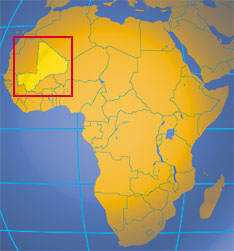
Mali is a landlocked country located in Western Africa which borders 7 different nations and is comprised of a variety of climates and terrains, most notably the Sahara.
HISTORY (abridged)
Malians declared independence from the French in 1960, but before that experienced a history of epic proportions, full of culture and turmoil, which has led to the saying a "poor country with rich people." The first legend to emerge from Mali Round 1230 was Soundiata Keita, who, despite being born without the use of his legs, was prophesied to be the greatest king in the world. After miraculously recovering the use of his legs, he went on to defeat Soumangourou Kante and unite the Malinke chiefs in the area under the first Mali Empire. Over the years modern day Mali had a variety of different ruling bodies including the Songhay Empire, the Moroccans, the Tukulor Empire, and the French. In 1960, Modibo Keita led his country to independence from the French with an alliance with Senegal. After Senegal withdrew from the Federation, Modibo Keita was elected its frist president, and went on to create a national, unconvertible currency, the Mali Franc, which had disastrous effects on Mali's economy. After Moussa Traore led a bloodless coup d'etat, the Comite Militaire de Liberation Nationale was established to resotre the economy before returning it to civilian rule, frustrated by a devastating drought from 1968 to 1974. Civilian unrest and student protests led to another coup, a transitional government, and a new constitution, and in 1992, Alpha Oumar Konare was elected the first democratic president. In 2002, he was succeeded by Amadou Toumani Toure who ran a campaign outside of any political party and won the presidency with a 68% majority vote. Today, Mali is one of the most politically stable countries in Africa.
CULTURE
Despite being one of the poorest nations in terms of GDP, Mali is considered to be rich in social capital. Social capital relates to cultural, spiritual, and human values, where interaction between people is more important than individual wealth. Based on mutual respect and interdependence, relations between different ethnic groups, is quite strong. Griots, or artisans, are not a high caste, but are nationally respected as the nation's keepers of its rich oral history. Through music and dance they retell stories of great warriors , chiefs, villains, and comedians who have made their country one of the most colorful in the world. There are two basic styles of music, Mande and Malinke , which are widely practiced, and many incorporate many native instruments, such as the kora, ngoni - string instruments - and the joun joun, and djembe, traditional African drums. Women are traditionally the story tellers and dancers, while men accompany them, though these gender roles are starting to blur.
Please be advised that this is a BRIEF summation of what I've been reading in travel books and online, and as someone who's never been to Mali I'm sure I'm missing some very crucial details. Please take a look at the Wikipedia article for Mali to learn more, and I'll be filling in more of the gaps as my travels educate me! Hope this helps, and stay tuned for a closer look at Mali's fascinating people.


No comments:
Post a Comment